
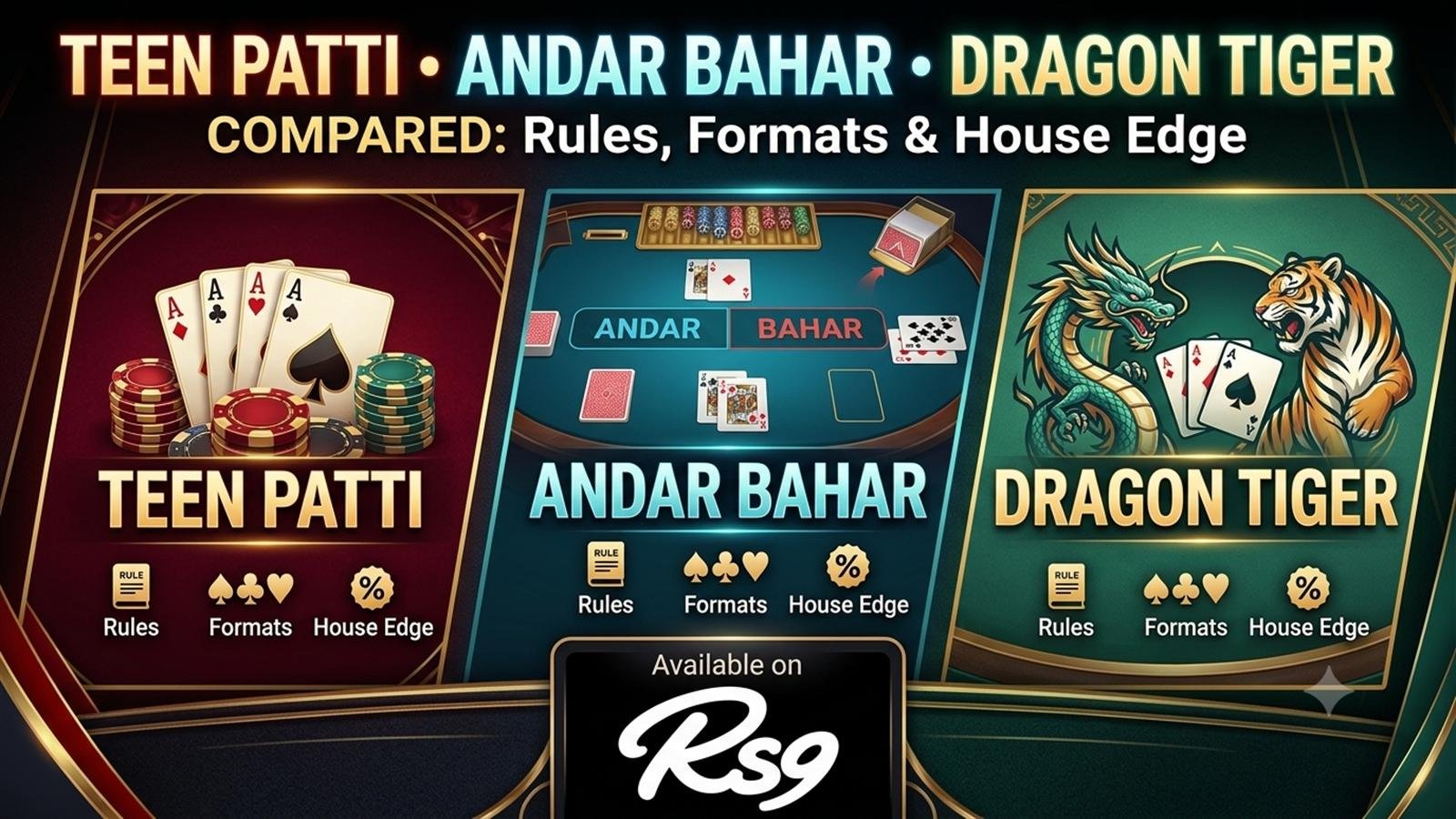
Open the Card & Table section of the rs9 lobby and three names dominate: Teen Patti in several variants, Andar Bahar, and Dragon Tiger. They look similar from the outside — a dealer, a deck, a countdown — but they differ enormously in round length, decision depth, volatility and how far a given deposit will stretch.
This article compares them properly, including the parts that usually get skipped: what the side bets actually pay relative to their true odds, and why the "roadmap" of previous results beside the table tells you nothing about the next hand.
Key takeaways
- Main bets are close; side bets are not. Across all three, the headline bets sit in a similar low band while side and tie bets carry several times the edge.
- Dragon Tiger is the fastest. Two cards, one comparison — great for short sessions, punishing for a small bankroll because rounds accumulate quickly.
- Andar Bahar is the simplest and the easiest to play at a measured pace, with the first-position bet typically the tightest wager available.
- Teen Patti has the most variation between titles — read each version's own paytable rather than assuming they match.
- The tie bet is a trap in every format. The headline multiplier looks generous precisely because the outcome is rare.
- Result histories are decoration. Every round is dealt independently; no run of outcomes changes what comes next.
The three formats at a glance
Before the detail, here is the shape of each one. Figures below describe how these formats are typically built across the industry — the exact paytable on any given table is shown inside that game's own info panel, and that is the number that applies to you.
| Teen Patti | Andar Bahar | Dragon Tiger | |
|---|---|---|---|
| Cards per round | 3 per hand, two hands | 1 joker, then alternating deal | 2 total |
| Typical round length | 30–45 seconds | 25–60 seconds (variable) | 20–30 seconds |
| Main bet | Player A vs Player B | Andar vs Bahar | Dragon vs Tiger |
| Main bet payout | Roughly even money, commission varies by title | Slightly under even money on first position | Even money |
| Tie / draw outcome | Yes, paytable varies | No true tie | Yes — usually returns half the main bet |
| Side bets | Many — pair plus, 3 of a kind, straight flush | Few — position/count ranges | Suit, big/small, specific card |
| Decision depth | Low in casino format; higher in peer-to-peer | Minimal | Minimal |
| Best suited to | Players who enjoy hand rankings and paytables | Beginners and slower, measured sessions | Short sessions and quick decisions |
Teen Patti: rules, hand rankings and variants
Teen Patti — literally "three cards" — is the most familiar card game in India and the one most people arrive already knowing. What is worth understanding is that the version in an app lobby is not the game you played at a family gathering.
How the casino format works
In the app version, the dealer deals two three-card hands — commonly labelled Player A and Player B — from a standard 52-card deck. You bet on which hand will be higher before the cards are revealed, and the hands are compared using standard Teen Patti rankings. You are not playing against other people and you are not making betting rounds; you are backing an outcome against a fixed paytable.
Hand rankings, highest to lowest
- Trail / Trio — three of a kind. Three aces is the strongest hand in the game.
- Pure sequence / Straight flush — three consecutive cards of the same suit.
- Sequence / Straight — three consecutive cards, mixed suits.
- Colour / Flush — three cards of one suit, not in sequence.
- Pair — two cards of the same rank.
- High card — none of the above; highest card decides.
Note the ordering quirk that surprises poker players: a sequence beats a flush in Teen Patti, because with only three cards a run is rarer than three of one suit. Get that the wrong way round and you will misread the paytable.
Side bets and where they cost you
Most app versions add optional side bets — commonly a "pair plus" style wager paying on the strength of a specific hand regardless of which side wins, and bonus wagers on trails or straight flushes. These are where the edge concentrates. A trail is genuinely rare, so the headline multiplier looks impressive; the payout is nonetheless set below the true odds, and by a wider margin than the main bet.
The rs9 lobby carries several Teen Patti titles — 2D and HD versions, joker variants, and studio-specific builds. They share the hand rankings but not the paytables, commission structure or side-bet list. Open the info panel on the specific table you are joining rather than assuming it matches the last one.
Common table formats you'll see in the lobby
"Teen Patti" in an app lobby is really an umbrella term. Under it sit several distinct table formats, and the name on the tile tells you which rules apply before you even open it. Knowing the difference in advance saves a confused first round.
| Format name | What's different | Good for |
|---|---|---|
| Classic / 1 Day | The standard Player A vs Player B format described above, with a full betting round removed — one bet, one reveal. | First-time players learning the hand rankings. |
| Joker / Wild Draw | One or more cards are designated wild for that round, which changes the odds of forming a trail or pure sequence. | Players who want the hand distribution to feel less predictable. |
| Muflis (Lowball) | Hand rankings invert — the lowest-value hand wins instead of the highest. A trail of aces becomes the worst hand on the table, not the best. | Players who already know standard rankings and want a genuine variant, not just a reskin. |
| AK47 / Community-card builds | Specific ranks (commonly Aces, Kings, 4s and 7s) are marked as wild for every hand in the shoe, permanently shifting the odds of big hands. | Faster, higher-variance sessions — trails appear far more often than in classic rules. |
| 2 Cards | Only two cards are dealt per hand instead of three, with a compressed ranking list (pairs and high cards dominate). | Quicker rounds with a simpler hand-reading task. |
None of these change the underlying principle: you are backing an outcome against a fixed paytable, not making live betting decisions against another player. The variant name changes which hands are strong and how often — it does not add strategic depth back into the casino format.
Andar Bahar: the simplest game in the lobby
Andar Bahar has perhaps the shortest rulebook of any real-money card game, which is exactly why it works well for players who want to watch a round unfold without tracking anything.
The joker is revealed
The dealer turns one card face up in the middle. This is the joker — the card the round is about.
You bet Andar or Bahar
Andar means "inside", Bahar means "outside" — simply the two sides of the table. You are betting on which side will receive a card matching the joker's rank first.
Cards are dealt alternately
The dealer places cards alternately on each side, starting with the side determined by the joker's colour or suit under that table's rules.
First match wins the round
The moment a card matching the joker's rank appears, that side wins. The round can end on the first card or run for dozens.
Why the two sides don't pay the same
The side that receives the first card has a marginally better chance of hitting the match, simply because it gets one extra opportunity. Operators correct for this by paying that side slightly less than even money — often around 0.9 to 1 — while the other side pays even money. That asymmetry is not a trick; it is the mathematics being priced in, and it is why the first-position bet typically ends up with the tightest house edge on the table despite paying less.
Side bets
Common extras include wagering on how many cards will be dealt before the match — bands such as 1–5, 6–10, 11–15 and so on — and on the suit of the winning card. These carry a noticeably higher edge than the main wager. They are entertaining, and they are the fastest way to shorten a session.
Where the game comes from, and why the board looks the way it does
Andar Bahar originated in southern India, most commonly traced to Karnataka and Andhra Pradesh, as a home and street game played with a physical deck long before it reached a screen. That history explains a few things newer players notice on the digital version: the "joker" terminology, the inside/outside naming, and the simple binary bet all come straight from the original tabletop version rather than being invented for an app.
Most rs9 tables display a small counter or progress strip showing how many cards have been dealt to each side so far in the current round. This is purely informational — it tells you where the round currently stands, not where it is going. Because the deal alternates and either side can match the joker on any card, watching the counter does not give you an edge; it only tells you how long the round has been running.
Unlike Teen Patti or Dragon Tiger, where the wager is placed against an unrevealed outcome, Andar Bahar shows you the card the round depends on — the joker — before you bet. That makes it the most transparent of the three formats: there is nothing hidden about the target, only about how many cards it will take to reach it.
Every game in the lobby has its own page
All 105 titles — including every Teen Patti variant, Andar Bahar and Dragon Tiger — have a detail page describing the format and what to check before staking.
18+ only · Outcomes are independent on every round · Play responsibly.Dragon Tiger: two cards, one decision
Dragon Tiger is sometimes described as baccarat stripped to its bones, and that is accurate. One card goes to Dragon, one to Tiger, higher card wins. There is no drawing rule, no hand construction, nothing to interpret. Aces are low; king is high.
The three bets
- Dragon — pays even money if the Dragon card is higher.
- Tiger — pays even money if the Tiger card is higher.
- Tie — pays a large multiplier when both cards share a rank. Rare, and priced well below its true odds.
The important detail is what happens to your main bet on a tie. On most tables, a tie returns half your Dragon or Tiger stake rather than the whole thing. That half-loss on ties is precisely where the house edge on the main bets comes from — it is a small rule with a real cost, and it is the reason the main bets are not a coin flip despite looking like one.
Side bets
Common extras include suit bets, and big/small wagers on whether the winning card is above or below a threshold. As everywhere else in this article, the side bets carry a materially higher edge than the main wager.
What the numbers on the side bets actually mean
It helps to see why these payouts are shaped the way they are, rather than take it on faith. A big/small bet is deciding whether the winning card falls above or below the middle of the range (7 is usually excluded from both). Roughly six ranks sit on each side of that line, so the true odds are close to even — yet big/small typically pays slightly under even money, which is where its edge comes from. A suit bet, by contrast, is picking one of four suits for the winning card: true odds are close to 3-to-1 against, and the table pays a fixed multiplier set below that figure. The pattern repeats across every side bet in every format in this article — the rarer the outcome, the wider the gap between the advertised multiplier and the true odds tends to be.
Table limits and multi-seat play
Because a round takes seconds, Dragon Tiger tables commonly support many simultaneous players betting on the same two cards, and often let a single player split a stake across Dragon, Tiger and one or two side bets in the same round. Splitting does not change the underlying edge on either wager — it only changes how your stake is distributed. Treat each portion as its own bet with its own edge rather than assuming a split stake is inherently safer.
Dragon Tiger's speed is its defining feature. Rounds resolve in twenty seconds, which means a bankroll that would last an hour elsewhere can be through in fifteen minutes. That is a session-management issue, not a game-quality issue.
The thing to plan forLive dealer vs RNG tables: what actually changes
All three formats in this article typically appear in two forms in the lobby: a live dealer table streamed from a studio, and an RNG (random number generator) table rendered entirely in software. They look similar in the app, but a few practical differences are worth knowing before you pick one.
| Live dealer | RNG / software table | |
|---|---|---|
| How outcomes are decided | A real dealer shuffles and deals a physical deck on camera | A certified random number generator determines the result |
| Round pacing | Fixed by the dealer and studio — steadier, less rushed | Often faster and player-paced, sometimes with an auto-play option |
| Data usage | Noticeably higher — it is a continuous video stream | Low — only small data packets and light graphics |
| Demo / practice mode | Rarely available, since a real dealer is running the round | Frequently available, depending on the studio |
| Seats and table limits | Often shared with many simultaneous players | Usually a single-player table with its own limits |
| Best on | Wi-Fi, when you want the social, "real table" feel | Mobile data, or when you want to practise a paytable first |
Neither format is mathematically better by default — the house edge is a function of the paytable, not of whether a human or a generator produced the card. Choose based on your connection, your data budget, and whether you actually want the atmosphere of a shared table. If you are new to a specific variant's rules, an RNG table with a demo mode is the cheapest way to get comfortable with the paytable before you play it live.
Where the house edge actually sits
Here is the honest summary. The main bets across all three formats sit in a broadly similar, comparatively low band — which is why these games are enjoyable to play but poor vehicles for clearing a wagering requirement. The side bets are a different category entirely.
| Bet type | Relative edge | What it means in practice |
|---|---|---|
| Andar/Bahar first position | Lowest | The tightest wager of the three formats, which is why it pays under even money. |
| Dragon / Tiger main bet | Low | Even money, with the half-loss on ties supplying the edge. |
| Teen Patti main bet | Low, varies by title | Commission structure differs between versions — check each paytable. |
| Andar Bahar card-count bands | Moderate to high | Fun, considerably more expensive than the main bet. |
| Teen Patti pair-plus / bonus bets | High | Large multipliers on rare hands, priced well below true odds. |
| Any tie bet | Highest | The headline multiplier is generous-looking because the outcome almost never happens. |
Every table carries an info or rules panel — usually behind an "i" icon — listing the exact paytable, the return-to-player figure and the side-bet payouts for that specific title. That panel is authoritative. Any figure quoted on any affiliate site, this one included, is a general description of how these formats work.
Round speed, bankroll and picking your format
House edge is only half the story. The other half is how many rounds per hour you play, because your expected cost is edge multiplied by total turnover. A faster game with the same edge costs more per hour, simply because more money passes through it.
| Format | Approx. rounds/hour | ₹50 flat stake = turnover/hour | Suits |
|---|---|---|---|
| Dragon Tiger | ~110–140 | ₹5,500 – ₹7,000 | Short, decisive sessions |
| Teen Patti | ~80–110 | ₹4,000 – ₹5,500 | Players who enjoy hand rankings |
| Andar Bahar | ~60–100 | ₹3,000 – ₹5,000 | Longer, slower play on a small bankroll |
The practical reading: if you have ₹1,000 and want it to last an evening, Andar Bahar at a small flat stake on the main bet gives you the most rounds for your money. If you have twenty minutes and want a decision every few seconds, Dragon Tiger is built for that — just size your stake for twenty minutes of a fast game, not twenty minutes of a slow one.
Decide the amount and the time before the first round, not during it. Use the deposit limit and session reminder tools in account settings so the decision is enforced rather than remembered. Every round is independent, the mathematics favour the house over time, and no amount of play changes either fact.
Two staking plans, and why one of them survives losing streaks better
Once the session budget is set, the next decision is how you size individual bets within it. Two approaches cover most of what you'll see recommended, and they behave very differently over a losing run.
- Flat betting. The same stake every round, regardless of the previous result. If your session budget is ₹1,000 and you flat-bet ₹20, you get roughly 50 rounds of play before the budget is spent, and a losing streak costs exactly what it looks like — no more, no less. This is the simplest plan to track and the easiest to stop cleanly.
- Proportional (percentage) betting. Each stake is a fixed percentage of your current balance rather than a fixed rupee amount — for example, always staking 2% of whatever remains. The stake shrinks automatically as the balance falls, which extends how long a losing run takes to exhaust the bankroll, at the cost of also shrinking the stake during a winning run.
What does not belong on this list is any progressive system that raises the stake after a loss to "catch up" — Martingale and its variants. Section 09 below covers why that specific approach fails mathematically rather than just being risky in practice.
Setting a stop-loss and a walk-away win
A complete staking plan has two exit points decided in advance, not just a total budget:
- A stop-loss — the point at which you close the app regardless of how the last few rounds felt. A common rule of thumb is stopping once roughly half the session budget is gone, which leaves the rest for another day rather than chasing it back in one sitting.
- A walk-away win — a target gain at which you stop rather than continuing on the theory that a hot run will keep going. Rounds are independent, so a streak carries no more predictive weight going forward than it did at the start.
Neither number needs to be large or sophisticated. What matters is that both exist before the first round, and that you actually follow them when the number is hit — the deposit limit and session tools mentioned above exist specifically to make that easier than relying on willpower alone.
Which format should you open tonight? A 60-second decision guide
If the comparisons above are more detail than you need right now, here is the short version — a handful of questions that point at one format over the other two.
| If this is you… | Open this |
|---|---|
| You have ₹500 and want it to last the whole evening | Andar Bahar, first-position bet, flat stake at the table minimum |
| You have fifteen minutes on a break and want quick decisions | Dragon Tiger, Dragon or Tiger only — skip the tie and side bets |
| You enjoy reading a paytable and want variety between sessions | Teen Patti — try Classic first, then Muflis once the rankings feel automatic |
| You're brand new to all three and unsure where to start | Andar Bahar — shortest rulebook, joker is shown before you bet, nothing hidden |
| You're trying to make a bonus's low-contribution table games last | Any of the three on the main bet only — see the bonus-wagering caveat in the FAQ below |
| You want the closest thing to a "social" table experience | A live dealer table in any of the three — see the comparison above |
Six myths worth dropping
1. "The roadmap shows a pattern"
The result history displayed beside a live table is a convenience feature, not a prediction tool. Cards are dealt from a shuffled shoe and each round is independent. Eight Dragons in a row does not make Tiger due; the ninth round has the same probabilities as the first. This is the gambler's fallacy, and it is the single most expensive belief in the category.
2. "Doubling after a loss guarantees recovery"
Progressive staking systems feel logical and fail for two concrete reasons: table maximums cap how far you can double, and your bankroll runs out before the sequence completes. What they actually do is convert a high chance of a small win into a small chance of a catastrophic loss. The expected value does not change — only the shape of the risk does.
3. "Card counting works here"
Counting relies on a depleting shoe carrying information forward. Most online tables reshuffle frequently — often every round — and the video streams are not structured for it. Whatever advantage the technique offers elsewhere does not transfer to this environment.
4. "Side bets are worth it for the multiplier"
A 50× payout on an outcome that occurs less than once in 50 attempts is a worse bet than an even-money wager, not a better one. Big multipliers are priced to look attractive precisely because the outcome is rare. Take them for entertainment if you enjoy them — just do it knowing they cost more per rupee staked than the main bet.
5. "A higher-stake table has better odds"
Table minimum and maximum limits change how much money moves through a round; they do not change the paytable or the underlying house edge. A ₹500-minimum table and a ₹10-minimum table running the same title pay the same odds on the same bets. Higher limits exist for players who want larger stakes per round, not better mathematics.
6. "Switching tables changes your luck"
Moving to a different table — or from an RNG table to a live one — resets nothing about probability. Each table runs its own independent shuffles or generator seed; there is no shared "hot" or "cold" state that carries between them. If a session feels like it needs a change, switching can be a reasonable way to reset your own attention and pacing — just don't expect it to change the odds of the next round.
Frequently asked questions
On the main bets, all three sit in a broadly similar low band, with Andar Bahar's first-position bet and Dragon Tiger's main bets typically the tightest. The large differences appear on side bets and tie bets, which carry several times the edge. Check the specific table's info panel for the exact figures.
Peer-to-peer Teen Patti involves betting decisions and reading opponents, so skill genuinely affects results. The casino-style versions in an app lobby are structured differently — you back an outcome against a fixed paytable, decisions are limited, and the mathematics are set. Do not assume the strategic depth of the social game carries over.
Usually only partially. Card and live table games commonly contribute 10% or less of each stake toward a wagering requirement, precisely because their house edge is low; slots typically contribute 100%. Our welcome bonus article works through what that means in rupees.
Because it receives the first card and therefore has one extra chance to hit the match. The reduced payout prices that advantage in. It is not a disadvantage to you — that bet still typically carries the lowest house edge on the table.
Availability of demo modes varies by title and studio, and live dealer tables generally do not offer one because a real dealer is running the round. Where a demo exists it is the cheapest way to learn a paytable. Where it does not, start at the table minimum until the flow is familiar.
Noticeably more than slots or card games with rendered graphics, because a live table is a video stream. If your data plan is tight, play live formats on Wi-Fi and keep the non-live versions for mobile data. Most tables let you lower the stream quality, which helps considerably.
The outcome mechanism — a certified random number generator versus a filmed dealer with a physical deck — plus pacing, data use and seat capacity. The house edge is set by the paytable, not by which mechanism produced the card, so neither version is inherently more favourable. See the full comparison table above.
Flat betting — the same stake every round — is the simplest plan to track and gives you a predictable number of rounds per session budget. Proportional staking, where the bet is a percentage of your current balance, stretches a losing run further at the cost of shrinking your stake in a winning one. Avoid any system that increases the stake after a loss to "catch up" — see the myths section above for why that fails.
No. Minimum and maximum limits control how much money can move through a round — they don't change the paytable. A ₹10-minimum table and a ₹500-minimum table running the same title pay identical odds on identical bets.
The short version
Stick to the main bets — Andar/Bahar on first position, Dragon or Tiger, or the primary Teen Patti hand wager — and you are playing the tightest version of each game. Treat every side bet and every tie bet as entertainment you are paying extra for, because that is exactly what they are. Match the format to your session: Andar Bahar to make a small bankroll last, Dragon Tiger when you have fifteen minutes, Teen Patti when you want the paytable to be part of the fun.
And ignore the roadmap. Every round is dealt fresh, no history predicts the next outcome, and the only thing genuinely within your control is how much you stake and how long you play.